



It starts around 2 p.m. A sharp, burning ache right under the ball of your foot. By the walk to your car, every step feels like you're standing on a hot pebble.
You assume your feet are just soft, or the shoes need more breaking in.
They don't. And they won't.
Ball of foot pain has less to do with toughness than you'd think, and a lot to do with what's strapped to your feet. Most men reach for the wrong dress shoes for foot pain because nobody told them what's actually happening down there. Let's get into it.
What's Actually Happening Inside Your Shoe
Ball of foot pain (metatarsalgia) comes from too much pressure landing on too small an area, right on the metatarsal heads behind your toes. That hot pebble feeling has a name. Several, actually. But the source is simple: that pressure piles up, over and over, until the tissue gives up.
Here's the anatomy in plain terms.
- Metatarsal heads are the knuckle-like joints sitting right behind your toes. They're the bumps you feel when you press the ball of your foot.
- When you walk, these joints carry a big share of your body weight at push-off.
- Squeeze them together or pile on repeated pressure, and the surrounding tissue inflames.
That inflammation is metatarsalgia. It's the word for ball of foot pain, and the Cleveland Clinic describes it as pain and inflammation in this exact spot. So no, you're not imagining it.
The same mechanical stress tends to invite company. Morton's neuroma, where nerve tissue thickens between the toes, often shows up from crowding. So do bunions, those bony bumps that form when your big toe gets pushed sideways for years.
Notice the pattern. None of this is random. It's a predictable result of how forces distribute across a foot that's been squeezed, tilted, and crowded by a shoe that ignores its shape.
Which means the fix isn't tougher feet. It's better mechanics.
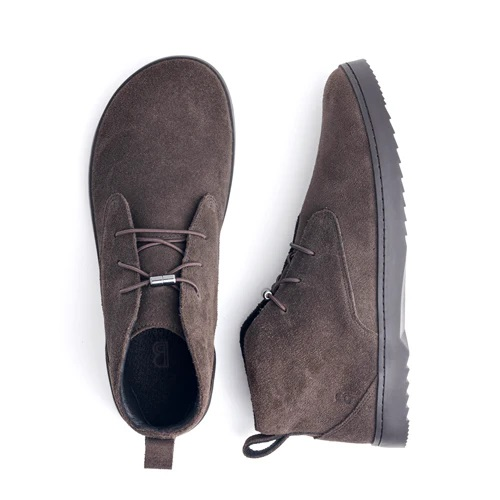
If you want to skip the science and just see what a better dress shoe looks like, see the Brenston.
Why Your Dress Shoes Are Doing This to You
Three dress shoe design flaws cause ball of foot pain: a raised heel drop, a rigid sole, and a narrow toe box. None of them were made with your metatarsal heads in mind, and together they gang up on your forefoot.
- The slope. Most dress shoes carry a heel-to-toe drop that tilts your weight forward onto the ball of your foot. It's a milder version of what happens in high heels, just dressed in oxford clothing. Birchbury breaks down why heel elevation wrecks your feet in more detail elsewhere.
- The sole. A rigid sole stops your foot from flexing through the natural gait cycle, so the forefoot absorbs the load your whole foot should share. That's how rigid soles overload the forefoot.
- The toe box. Narrow toes squeeze your foot together and pile pressure onto the metatarsal heads instead of spreading it out. No arch support insert or rocker sole fixes a shoe that was shaped wrong from the start.
Ever wonder why your feet feel fine in sneakers but wrecked in oxfords? It's the stack of all three.
| Feature | Conventional Dress Shoe | What Your Foot Needs |
|---|---|---|
| Heel drop | Raised heel height | Zero-drop, flat from heel to toe |
| Sole flexibility | Stiff and rigid | Flexible, bends with your foot |
| Toe box width | Narrow and tapered | Wide, room for toes to splay |
Heel height, rigidity, and narrowness together make a triple threat for forefoot pressure. And this isn't a hunch. Peer-reviewed research points to repeated transfer of plantar pressures to the forefoot during gait as the underlying driver of metatarsalgia.
So the shoe isn't breaking in. It's just doing exactly what its design makes it do.
Three Features That Decide Whether Your Feet Survive the Workday
Three features prevent ball of foot pain: a zero-drop heel, a wide toe box, and a flexible sole. They do most of the heavy lifting, and they're basic biomechanics most shoe companies skip because tradition beats rethinking a last.
Heel-to-Toe Drop (and Why Zero Matters)
Zero-drop means your heel and toe sit at the same height. No slope. No forward tilt. Your weight stays spread across the whole foot instead of dumping onto the ball.
Most dress shoes do the opposite. Raise the heel even a little and gravity slides your load toward those already-overworked metatarsal heads. Level the platform and the pressure redistributes.
The Brenston runs flat from heel to toe. Looks like a standard oxford, but underneath, nothing pushes your weight forward. That single choice beats any insert you could slide in afterward.
Toe Box Width and Natural Splay
Your toes are supposed to spread when you walk. That splay isn't a flaw. It's how the foot shares load across all five metatarsal heads at push-off.
A narrow, tapered toe box pins your toes together, so weight that should fan out across five points piles onto two or three. More pressure, less surface area, same sore spot by 2 p.m.
A wide toe box gives your toes room to do their job. The Brenston is shaped wide where your foot is widest, so your toes splay instead of stack. Load spreads the way nature intended.
Sole Flexibility vs. Cushioning
A flexible sole, not more cushioning, fixes forefoot pain. Most people feel the pain and add padding. More cushioning, more shock absorption, surely that's the answer.
It isn't. Padding masks the problem for an hour, then you're right back where you started. The real fix is a sole that bends, letting your foot move through its natural gait cycle so impact spreads across each step instead of slamming the forefoot.
What to look for in a sole:
- Flexible enough to bend with your foot, not against it
- Thin enough for genuine ground feel
- A removable insole, so you can swap the footbed or add your own arch support without fighting the shoe's design
The Brenston checks all three. Flexible flat sole, full-grain American leather, and a removable insole you can customize on your terms. Three features, one shoe, no compromise on how it looks with a suit.
Myths That Keep Your Feet Hurting
The footwear industry has spent decades telling you the problem is your feet. It isn't. Most of what you've been told about dress shoes for foot pain falls apart the second you poke at it. Here are the big ones.
- Myth: You have to choose between looking sharp and feeling good. Reality: This is a false trade-off invented by companies that haven't touched their shoe lasts in decades. Comfort and style aren't enemies. They were just never designed to coexist until someone bothered to try.
- Myth: A good insole or metatarsal pad solves the problem. Reality: It helps. For a while. But it's a band-aid on a structural flaw. You're padding a foot that's still being tilted and squeezed by the shoe around it.
- Myth: Dress shoes need a break-in period. Reality: If a shoe hurts on day one, the design is wrong, not your feet. Leather softens. It doesn't reshape a narrow toe box into a wide one.
- Myth: Barefoot shoes look weird. Reality: Some do. The toe-glove ones, yeah. But dress shoes now exist that look completely conventional and fit like barefoot shoes underneath. Nobody can tell.
None of this surprises the people who study it. The Mayo Clinic guidance lists changing your footwear as a primary self-care step for metatarsalgia and ball of foot pain. Not toughening up. Not breaking in. Changing the shoe.
What to Actually Look for in a Dress Shoe That Won't Wreck Your Feet
Five things make the difference: zero-drop, a wide toe box, a flexible sole, a removable insole, and full-grain leather. Enough theory. Here's the shopping list. Print it, screenshot it, whatever keeps it handy the next time you're staring at a wall of oxfords that all promise comfort and deliver blisters.
- Zero-drop or minimal heel-to-toe offset. Your heel and toe should sit at the same height. No forward tilt onto the ball.
- A wide toe box that lets your toes spread. Not just a wider size in the same narrow shape. Width where your foot is actually widest.
- A flexible sole that bends where your foot bends. Stiff soles fight your gait. A flexible one moves with you.
- A removable insole. So you can swap the footbed or add your own arch support without wrecking the fit.
- Full-grain leather that conforms over time. American full-grain molds to your foot shape without the brutal break-in. No bandaged heels for two weeks.
Skip the rocker sole gimmicks and metatarsal-pad add-ons. If the shoe is built right, you don't need to engineer your way around its flaws.
One honest note. If ball-of-foot pain sticks around even after you switch to better footwear, see a podiatrist. It can point to something beyond shoe design that's worth checking.
The Brenston was built on every point above. Zero-drop, wide toe box, flexible sole, removable insole, soft full-grain American leather that's comfortable from day one. It looks like a classic oxford. Nobody at the office will know the difference.
For days outside the office, the Bramford follows the same playbook in a clean sneaker. Same wide toe box, same zero-drop feel, none of the toe-glove look.
Your Feet Aren't the Problem, Your Shoes Are
Ball of foot pain is a shoe design flaw, not weak feet. Here's the truth buried under decades of break-in advice and insole upsells: that ache isn't a sign your feet failed. It's a design flaw you've been wearing.
Conventional dress shoes for foot pain tilt you forward, squeeze your toes, and stiffen under your stride. Then they sell you a pad to soften the damage. Toughing it out doesn't work. Choosing shoes built for how feet actually move does.
The Brenston proves you never had to pick between sharp and comfortable.
Prices accurate as of June 2026.
Frequently Asked Questions
Why Does the Ball of My Foot Hurt When I Wear Certain Shoes?
Too much pressure lands on too small an area. Shoes with a tilted heel, a narrow toe box, or a stiff sole concentrate your weight onto the metatarsal heads behind your toes. Swap those design flaws and the ache usually fades with them.
Will Metatarsalgia Go Away on Its Own?
Sometimes, if you stop irritating it. Keep wearing the shoes that caused it and the inflammation tends to stick around. Change your footwear first. If the pain lingers after that, a podiatrist is worth the visit.
Can a Dress Shoe Really Fit Like a Barefoot Shoe and Still Look Formal?
Yes. The barefoot features live underneath, where nobody sees them. A flat sole and a wide toe box hide inside a classic oxford shape, so the shoe looks sharp with a suit while your foot gets the room it actually needs.
Does a Wider Toe Box Actually Reduce Pressure on the Ball of the Foot?
Yes. When your toes can splay, your weight spreads across all five metatarsal heads instead of piling onto two or three. More surface area, less concentrated load. That's the whole point of giving the foot room to do its job.