




Written by Birchbury Team
Most men with plantar fasciitis blame their feet. Reasonable assumption. Wrong target.
The plantar fascia doesn't just randomly decide to ruin your morning. It responds to load, compression, and the angle your heel sits at for eight hours straight. Dress shoes rarely get evaluated for any of that. They get evaluated for how they look with a suit, which is a great way to pick a shoe and a terrible way to treat a plantar fascia.
Here's what your dress shoes are actually doing to your arch, and what to look for instead.
What Plantar Fasciitis Actually Does During a Workday
Plantar fasciitis is inflammation of the plantar fascia, a thick band of tissue running from your heel bone to the base of your toes. Its job is to support your arch under load. Every step, every hour on your feet, it absorbs force and springs back.
Overnight, it contracts. Tightens up like a rubber band left in the cold. Then your alarm goes off, your feet hit the floor, and those first steps stretch it fast. That's the micro-tearing. That's the heel pain that makes you walk like you're crossing hot gravel at 6 a.m.
Here's where work makes it worse.
Eight hours on hard office floors, in rigid dress shoes with elevated heels and no real arch support, repeats that damage cycle continuously. The fascia never gets a break. The heel cup in most dress shoes positions your heel at an angle that keeps the fascia under constant tension. It's not recovering. It's accumulating.
Research confirms that plantar fasciitis is predominantly a workday condition. 83% of plantar fasciitis patients are working adults between 25 and 65, according to peer-reviewed research. That's not a coincidence. That's a workday problem.
Why Your Dress Shoes Are Making It Worse
Your shoes aren't just failing to help. They're actively adding to the problem. Three specific design choices, baked into almost every conventional dress shoe on the market, turn a manageable condition into a daily grind.
The Heel Drop Problem
Most men's dress shoes carry a heel-to-toe drop of 10–15mm, meaning your heel sits significantly higher than your forefoot all day. The immediate effect: your Achilles tendon shortens to accommodate the angle. The downstream effect: the plantar fascia takes on more tension to compensate.
A heel drop above 8mm for a full workday means the fascia never gets to rest at its natural length. It stays loaded. Gait shifts. The heel strikes harder. Each step adds a little more strain to tissue that's already inflamed.
Eight hours of that isn't recovery. It's repetition.
Hard Soles and Zero Give
Rigid soles transmit impact directly into the heel with no shock absorption, worsening plantar fasciitis symptoms. A rigid shank and hard leather sole look sharp, but they also transmit impact directly into your heel with no buffer between you and the floor. Industry research links hard-soled dress shoes directly to worsening plantar fasciitis symptoms.
Add a narrow toe box and the problem compounds. Compressed toes can't splay naturally, which increases tension along the entire length of the plantar fascia. It's a hidden aggravator most men never connect to their heel pain.
The full picture:
- High heel drop (10–15mm) shortens the Achilles and overloads the fascia
- Rigid shank and hard sole eliminate shock absorption at the heel
- Narrow toe box prevents natural toe splay and increases fascial tension
- Combined over eight hours, every step becomes repeated micro-trauma
None of these features are accidents. They're design conventions built around aesthetics, not anatomy. Your feet are paying the price for someone else's style priorities.
What to Look for in a Dress Shoe That Won't Wreck Your Feet
Now that you know what's causing the damage, here's what to actually look for. Not every dress shoe is built the same way, and a few specific features separate the ones that help from the ones that hurt.
Wide Toe Box
Your toes need room to splay. When they can't, the plantar fascia stays under tension from end to end. A roomy toe box for foot relief lets the forefoot spread naturally under load, which reduces strain on the fascia with every step. Most dress shoes taper aggressively at the toe. That's a style choice. It costs you.
Zero-Drop or Low Heel-to-Toe Drop
A zero-drop sole keeps your heel and forefoot at the same height. That means your Achilles tendon stays at its natural length, and your arch loads the way it was designed to. No artificial shortening. No compensatory tension pulling at the fascia all day.
Thick cushioning under the heel raises the heel relative to the forefoot and encourages the same hard heel-strike pattern that aggravates plantar fasciitis. A flexible outsole with minimal drop lets your foot move through its natural gait cycle instead of fighting the shoe's geometry.
Removable Insole
If you use custom orthotics, this matters more than almost anything else. A removable insole means you can swap in your own arch support without cramming it on top of a fixed footbed. The shoe fits. The orthotic works. You're not just adding bulk.
How to check before buying: pull the insole out. If it lifts cleanly with no adhesive or stitching holding it down, it's genuinely removable. If it doesn't budge, it's decorative.
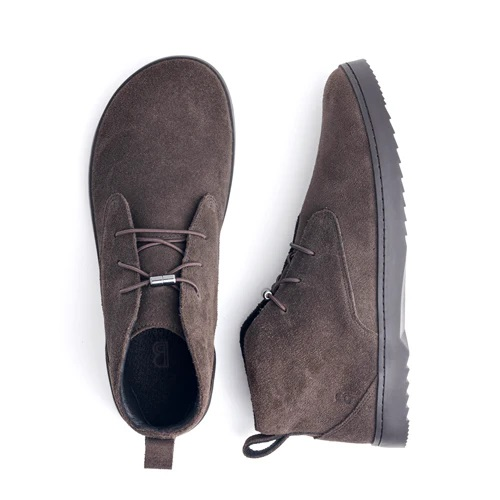
The Brenston: Barefoot Dress Shoe checks all of these boxes: wide toe box, zero-drop sole, full-grain American leather upper, and a removable insole sized for custom orthotics. It looks like a classic Oxford. It doesn't behave like one.
The table below compares traditional dress shoes versus barefoot dress shoes across five features relevant to plantar fasciitis.
|
Feature |
Traditional Dress Shoe |
Barefoot Dress Shoe
|
|---|---|---|
|
Heel Drop |
10–15mm |
0mm |
|
Toe Box |
Narrow, tapered |
Wide, foot-shaped |
|
Insole |
Fixed or glued |
Removable, orthotic-ready |
|
Sole Flexibility |
Rigid shank |
Flexible outsole |
|
Shock Absorption |
Minimal, heel-focused |
Distributed across the foot |
Explore dress shoes built for foot health →
What Most Men Get Wrong About 'Supportive' Dress Shoes
Here's the assumption most men make: more support equals better outcomes. More cushioning, more arch support, stiffer construction. The shoe does more, so your foot suffers less. It sounds right. It isn't.
Four common myths about supportive dress shoes lead men to make their plantar fasciitis worse.
-
Myth: More cushioning always helps. Reality: A thick cushioned midsole reduces the sensory feedback your foot uses to regulate how it lands. Over time, the muscles that control your arch weaken because the shoe keeps doing their job for them.
-
Myth: You need massive arch support built in. Reality: The arch is designed to load and spring back. Propping it up permanently stops it from doing that. The fascia doesn't get stronger. It gets dependent.
-
Myth: Stiff shoes protect the foot. Reality: Rigidity forces compensatory movement patterns up the chain, through ankles, knees, and hips. The foot can't move naturally, so something else pays for it.
- Myth: Barefoot shoes can't work for plantar fasciitis. Reality: A zero-drop sole and wide toe box let the foot move the way it evolved to. That's not reckless. That's the point.
There's a difference between supporting the foot and doing the foot's job for it. A shoe that handles everything leaves the foot with nothing to do, and nothing to do means nothing to strengthen.
That's the trap. The shoes marketed as the most supportive are often the ones making the underlying problem worse. Genuinely comfortable dress shoes work with the foot's mechanics, not around them.
How to Make the Switch Without Regretting It
Switching from a 12mm heel drop to zero overnight is a bad idea. Your Achilles tendon has been shortened for years. Give it time to catch up.
Here's how to do it without setting yourself back:
-
Start with 2–3 hours on day one. Your feet will tell you when they've had enough.
-
Add an hour or two each day over 2–3 weeks. Gradual load is the whole point.
-
Swap in your orthotics from the start. If you use custom orthotics, drop them into the new shoes during the transition. The Brenston: Barefoot Dress Shoe has a removable insole built for exactly this: pull it out, drop your orthotic in, done.
-
Roll a frozen water bottle under your arch for 10 minutes each evening. It manages inflammation while the plantar fascia adjusts to the new load pattern.
- Watch your morning pain. It should decrease week over week. If it's getting worse, slow down.
Morning heel pain is your progress report. A little soreness early on is normal. Escalating pain is a signal to back off, not push through.
The transition takes a few weeks. The alternative is another year in shoes that are quietly making things worse.
Prices accurate as of May 2026.
FAQs About Dress Shoes and Plantar Fasciitis
What Shoes Should You Avoid with Plantar Fasciitis?
Avoid anything with a heel drop above 8mm, a rigid sole, or a narrow toe box. That rules out most conventional dress shoes. Flat, unsupportive shoes with no arch support are equally problematic. Both extremes keep the plantar fascia under tension and prevent it from recovering between steps.
Can a Zero-Drop Dress Shoe Actually Help with Plantar Fasciitis Pain During a Full Workday?
Yes, but the transition matters. A zero-drop sole with a wide toe box lets the foot move through its natural gait cycle, reducing the fascial tension that builds up over eight hours. Go too fast and you'll trade one problem for another. Gradual wear-in over two to three weeks is the approach that works.
Are Ecco Dress Shoes Good for Plantar Fasciitis?
Ecco offers decent cushioning, which helps with impact. The issue is heel drop and toe box width. Most Ecco dress styles carry an elevated heel and a tapered toe, which keeps the Achilles shortened and the fascia loaded. Better than a rigid leather sole, but not addressing the root mechanics.
What's the Worst Thing You Can Do for Plantar Fasciitis?
Keep wearing the same shoes and hope it resolves. The pain signals that the load pattern is wrong. Ignoring it while repeating eight-hour days in high heel-drop, narrow-toe-box shoes doesn't give the fascia any chance to recover. The condition doesn't improve when the cause is still on your feet every day.
Your Feet Spend 8 Hours in Those Shoes — Choose Accordingly
Dress shoes are not a neutral choice. Every hour you spend in a high heel-drop, narrow-toe-box shoe is another hour the plantar fascia spends under load it wasn't designed to handle.
Three features define a dress shoe that won't worsen plantar fasciitis: a flat or zero-drop sole, a wide toe box, and a removable insole. Know those three things, and the next time you're standing in a shoe store, you'll know exactly what you're looking at.
Your feet have been in the wrong shoes long enough.