




Written by Birchbury Team
Most men accept foot pain as part of the deal. You put on a sharp pair of dress shoes, look the part, and spend the rest of the day quietly suffering. Blisters by lunch. Aching arches by three. Toes that feel like they've been in a vice since nine.
That's not a comfort problem. That's a design problem. Comfortable dress shoes exist, but most of what's sold as "comfortable" just means slightly less awful. This guide breaks down exactly what separates a dress shoe built for all-day comfort from one that just looks like it should be.
What Actually Makes a Dress Shoe Comfortable
A dress shoe is comfortable when it has a zero-drop sole, a wide toe box built into the last, and full-grain leather. Not because of added cushioning or marketing claims. Comfort in a dress shoe comes down to construction, specifically a handful of design decisions that most traditional dress shoes get completely wrong.
Zero-Drop Soles and Why Heel Elevation Wrecks Your Feet
Most traditional dress shoes have 10 to 15mm of heel elevation. That's not a style choice. It's a structural decision that shifts your body weight forward, compresses the front of your foot, and forces your calves and lower back to compensate all day long.
Peer-reviewed research links elevated heel design to increased forefoot pressure and foot fatigue, the kind that turns a long workday into a slow grind by mid-afternoon. A zero-drop sole keeps your heel and forefoot at the same height. Your weight distributes the way it's supposed to.
The fix isn't arch support or extra cushioning layered on top of a bad design. It's getting the geometry right from the start.
Wide Toe Box vs. Wide Width — They're Not the Same Thing
Wide width scales the whole shoe larger while keeping a tapered shape. A wide toe box is a structural feature of the shoe last that lets toes splay naturally. Most buyers get burned going up a width, from D to 2E, and wonder why their toes still feel crushed. The toe box shape stays the same. Your toes still taper into a point that no human foot actually has.
A wide toe box is built into the shoe last itself. It gives your toes room to splay naturally, the way they do when you're barefoot. That splay matters. It's how your foot stabilizes itself and absorbs impact.
- Wide toe box: Shaped to match the natural width of your forefoot. Toes sit flat and spread. Works with any standard width.
- Wide width (2E/4E): The entire shoe is scaled wider. The toe box silhouette stays narrow. Toes still compress at the tip.
- Wide toe box + standard width: Fits most feet better than a wide-width shoe with a tapered last.
If your toes are numb or cramped by noon, the problem isn't your foot size. It's the shoe last.
The Break-In Period Is a Red Flag, Not a Rite of Passage
You've heard it. Maybe you've said it. "Just wear them around the house for a few weeks."
Here's what's actually happening: the shoe wasn't built for the shape of a human foot. You're not breaking in the shoe. You're breaking down your foot to fit the shoe.
A dress shoe built on sound principles, soft full-grain leather, a foot-shaped last, zero-drop construction, should be comfortable from the first wear. Not eventually. Day one. Ergonomics research supports this: footwear that aligns with natural foot geometry reduces the adaptation period significantly. If a shoe needs weeks to stop hurting you, that's a design problem dressed up as tradition.
Materials That Work With Your Feet, Not Against Them
Full-grain leather is the best material for comfortable dress shoes because it molds to the foot over time while maintaining structure. It's the outermost layer of the hide, the densest, most durable part. Bonded leather and corrected-grain leather don't adapt. They stay stiff, breathe poorly, and stay uncomfortable.
The outsole matters too. Leather soles look traditional, but on hard floors and pavement they offer almost no shock absorption. A rubber outsole grips, flexes, and absorbs impact in a way leather simply can't match. That difference compounds over an eight-hour day on concrete.
Put it together: zero-drop geometry, a wide toe box built into the last, full-grain leather that moves with your foot, and a rubber outsole that handles the ground beneath you. That's what comfortable dress shoes are actually made of. Everything else is marketing.
Our Top Picks for All-Day Comfort
The features from the last section aren't abstract. They exist in actual shoes you can wear to work on Monday. Here are three that get it right.
Best Overall: Brenston Barefoot Dress Shoe
The Brenston: Barefoot Dress Shoe is a full-grain leather oxford with a wide toe box, zero-drop rubber sole, and elastic no-tie lacing, rated 4.5 stars across 615 reviews.
It looks like a classic oxford. That's the point. Put it next to a conventional dress shoe and most people can't tell the difference. What they can't see is the wide toe box, the zero-drop sole, or the soft full-grain American leather that's comfortable from the first wear.
No break-in. No toe compression. The elastic no-tie lacing system means it slips on like a loafer but fits like a proper oxford. The removable insole is worth noting too. If you use custom insoles, they drop straight in. Most wide toe-box leather shoes don't accommodate that. The Brenston does.
The most common note in reviews: people can't believe it's a barefoot shoe.
- Style: Classic oxford
- Leather: Full-grain American leather
- Sole: Zero-drop rubber
- Lacing: Elastic no-tie
- Orthotics compatible: Yes (removable insole)
- Rating: 4.5 stars (615 reviews)
Best for Casual Fridays: Bramford Barefoot Sneaker
The Bramford: Barefoot Sneaker is a leather barefoot sneaker with a wide toe box, zero-drop sole, and removable insole, rated 4.6 stars across 1,017 reviews, the most reviewed shoe in the lineup.
Not every day calls for an oxford. The Bramford covers the smart-casual end of the spectrum, the kind of shoe that works with chinos, dark denim, or anything in between. Same barefoot construction underneath: wide toe box, zero-drop sole, elastic no-tie laces, removable insole.
It's the hybrid dress shoe for commuters and anyone whose office runs business casual. People wear it everywhere and nobody clocks it as a barefoot shoe. That's the whole idea.
- Style: Clean leather sneaker
- Leather: Soft leather
- Sole: Zero-drop rubber
- Lacing: Elastic no-tie
- Orthotics compatible: Yes (removable insole)
- Rating: 4.6 stars (1,017 reviews)
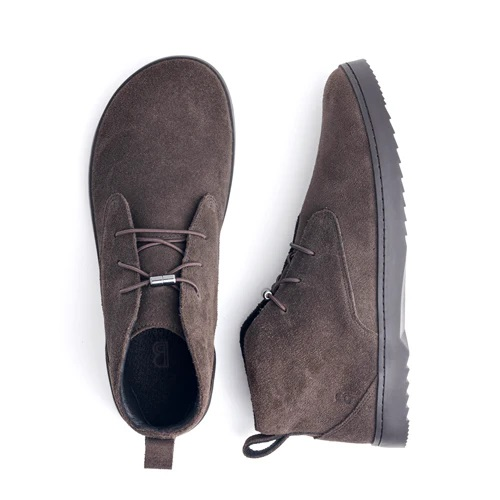
Best Boot Option: Carnforth Barefoot Chukka Boot
The Carnforth: Barefoot Chukka Boot is a water-resistant full-grain leather chukka boot with a wide toe box, zero-drop sole, and removable insole, rated 4.4 stars across 320 reviews.
It extends the same principles into boot territory. Full-grain American leather, wide toe box, zero-drop sole, water resistant. The barefoot shoe crowd tends to overlook boots, but the Carnforth is built for the same all-day wear as the rest of the lineup. No break-in period required.
- Style: Chukka boot
- Leather: Full-grain American leather
- Sole: Zero-drop rubber
- Lacing: Elastic no-tie
- Orthotics compatible: Yes (removable insole)
- Rating: 4.4 stars (320 reviews)
| Feature | Brenston | Bramford | Carnforth |
|---|---|---|---|
| Style | Oxford | Sneaker | Chukka Boot |
| Leather | Full-grain American | Soft leather | Full-grain American |
| Sole | Zero-drop rubber | Zero-drop rubber | Zero-drop rubber |
| Orthotics Compatible | Yes | Yes | Yes |
| No-Tie Laces | Yes | Yes | Yes |
| Rating | 4.5 (615) | 4.6 (1,017) | 4.4 (320) |
Traditional Dress Shoes vs. Barefoot Dress Shoes
The choice sounds simple. It isn't. Most men don't realize how much the shoe last, heel height, and leather stiffness are working against them until they've already spent a full day paying for it.
Six key differences separate traditional dress shoes from barefoot dress shoes: heel height, toe box shape, break-in period, arch support approach, insole compatibility, and appearance. Here's the honest side-by-side.
- Heel height: Traditional dress shoes run 10 to 15mm of heel elevation, shifting weight forward and loading the forefoot. Barefoot dress shoes use a zero-drop sole, heel and forefoot at the same level, weight distributed the way your body expects.
- Toe box: Traditional shoes are built on a tapered shoe last that narrows toward the tip. Barefoot dress shoes use a foot-shaped last with a wide toe box, so your toes sit flat and spread naturally instead of stacking.
- Break-in period: Traditional leather dress shoes are stiff out of the box. You're expected to suffer through weeks of wear before they stop hurting your feet. Barefoot dress shoes built with soft full-grain leather are comfortable from day one.
- Arch support and cushioning: Traditional shoes often rely on built-in arch support and thick cushioning to compensate for poor geometry. Barefoot dress shoes address the geometry first, so your foot does what it's designed to do.
- Insole options: Most traditional dress shoes have fixed insoles with no room for custom orthotics. Barefoot dress shoes typically include removable insoles that accommodate them.
- Appearance: This used to be the dealbreaker. Early barefoot shoes looked like something you'd wear to a yoga retreat. That's no longer true. A well-made barefoot dress shoe now looks indistinguishable from a conventional oxford.
The evidence isn't subtle. Traditional dress shoes prioritize silhouette. Barefoot dress shoes prioritize the foot inside the shoe, and then build the silhouette around it.
Foot fatigue at the end of a long day isn't inevitable. It's a design outcome. And design outcomes can change.
Frequently Asked Questions
What Is the Difference Between Wide Toe Box and Wide Width in Dress Shoes?
Wide width scales the entire shoe bigger while keeping the same tapered silhouette. Your toes still compress at the tip. A wide toe box is a shape built into the shoe last itself that matches the natural spread of your forefoot. Different problem, different solution. Most men who need a wide toe box don't actually need a wide-width shoe.
Do Comfortable Dress Shoes Have to Look Casual or Can They Work in Formal Settings?
No. A well-built barefoot dress shoe like the Brenston is visually indistinguishable from a conventional oxford. Same silhouette, same clean lines. The difference is entirely internal: wide toe box, zero-drop sole, soft leather. Nobody in the boardroom will know. That's the point.
What Does Zero-Drop Mean in a Dress Shoe and Why Does It Matter?
Zero-drop means the heel and forefoot sit at the same height. No elevation, no forward tilt. Your weight distributes evenly, your posture stays neutral, and your lower back and calves aren't compensating all day. Most traditional dress shoes have 10 to 15mm of heel elevation, per peer-reviewed research. That gap is where foot fatigue starts.
Can I Use Custom Orthotics in a Barefoot Dress Shoe?
Yes, if the shoe has a removable insole. The Brenston includes one specifically for this reason. Pull out the stock insole, drop in your custom insoles, and the fit stays clean. Most traditional dress shoes don't give you that option. The insole is glued in and that's that.
Why Do Most Dress Shoes Require a Break-In Period and Is That Normal?
It's common. It's not normal. A break-in period means the shoe was built on a generic last that doesn't match foot anatomy. You're not softening the shoe. You're reshaping your foot to fit it. A dress shoe built with soft full-grain leather and a foot-shaped last should be comfortable from the first wear. Day one, not week three.
Your Feet Already Know the Answer
Comfortable dress shoes aren't a category of their own. They're just dress shoes built correctly. Zero-drop sole. Wide toe box. Full-grain leather that works with your foot from day one. No break-in period, no trade-off between looking sharp and feeling good.
All-day comfort in a dress shoe isn't a luxury feature reserved for casual Fridays. It's what happens when a shoe is designed around the foot inside it instead of the silhouette outside it. The men who figured this out stopped dreading long days on their feet. They also stopped changing into sandals the second they got home.
You don't have to settle for shoes that hurt your feet. That was always a design problem. Now you know how to spot it.
Prices accurate as of May 2026.