




Written by Birchbury Team
Every step you take, your foot rolls. That's not a problem. That's the gait cycle doing its job. The problem is when it rolls too far in one direction, and you have no idea it's happening until your knees start complaining or your lower back joins the conversation.
Most people only find out they overpronate or supinate after something hurts. This article breaks down what each pattern actually means, how to tell which one you have, and what to do about it.
What Overpronation and Supination Actually Are

Neutral Pronation: The Baseline
Neutral pronation means the foot rolls inward about 15% after heel strike. That's enough to absorb shock, distribute load, and push off cleanly. Every foot does this. It's normal. It's the gait cycle working exactly as designed.
Overpronation: Too Far Inward
Overpronation is when the foot rolls inward beyond the normal range, causing the arch to collapse under load instead of springing back. As Cleveland Clinic explains, this pattern is common with flat feet, where the arch has little structure to resist the inward force. The ankle rolls in, the knee tracks inward with it, and the stress travels up the chain from there.
Supination: Too Far Outward
Supination is when the foot rolls outward after heel strike, keeping weight on the outer edge. High arches are the usual culprit: a rigid foot that doesn't absorb shock well and doesn't distribute load evenly. The outer edge of the shoe wears down fast. The ankle has less stability on uneven ground.
Both patterns are deviations from neutral. Neither is a character flaw. Here's how they compare:
| Feature | Overpronation | Supination |
|---|---|---|
| Foot roll direction | Inward (excessive) | Outward |
| Typical arch type | Low or flat | High |
| Common foot shape | Flat feet | High-arched foot |
| Shoe wear location | Inner heel and ball | Outer heel and forefoot |
| Common injuries | Plantar fasciitis, shin splints | Achilles tendonitis, IT band syndrome |
| Recommended footwear feature | Wide toe box, zero-drop sole | Cushioned, flexible sole |
Why Your Gait Pattern Matters More Than You Think
Foot misalignment doesn't stay in the foot. It travels up the kinetic chain to the knees, hips, and lower back. A study published in the British Journal of Sports Medicine found that foot misalignment creates a chain reaction through the kinetic chain, and problems that start at the arch don't stay there. Your gait pattern isn't just a quirk. Left unchecked, it becomes a source of real, recurring pain.
Overpronation stresses the arch, ankle, and inner knee. The arch collapses repeatedly under load, and the surrounding structures absorb what it can't. Common injuries include:
- Plantar fasciitis
- Shin splints
- Bunions
- Inner knee pain
Supination concentrates impact on the outer foot. Without adequate arch support to distribute load, the outer structures take a beating. Common injuries include:
- Achilles tendonitis
- Stress fractures
- IT band syndrome
- Ankle sprains
Neither pattern is automatically worse than the other. Both create problems when ignored. The difference is where the pain shows up first.
That's the part most people miss. They treat the symptom, the sore knee, the tight heel, without ever looking at what's driving it. The foot is where the story starts.
How to Tell Which Gait Pattern You Have
Three at-home tests can point you toward your gait pattern: the wet foot test, the shoe wear pattern check, and the standing visual check. Think of them as a starting point, not a verdict. They give you useful information, not a clinical diagnosis. If you're dealing with persistent pain, a professional gait analysis is worth the time.
- The wet foot test. Wet your foot, step onto a piece of cardboard or concrete, and look at the imprint. A nearly full footprint with little arch definition points to flat feet and likely overpronation. A thin strip along the outer edge with a big gap in the middle suggests high arches and possible supination.
- The shoe wear pattern check. Flip over your most-worn pair. Heavy wear on the inner heel and ball of the foot signals overpronation. Wear concentrated on the outer edge points toward supination.
- The standing visual check. Look at your feet while standing naturally. Collapsed arches that touch or nearly touch the floor lean toward overpronation. A pronounced, rigid arch with weight sitting on the outer foot leans toward supination.
A podiatrist or sports physio can tell you exactly what's happening and rule out anything structural. Still, most people find the shoe wear pattern alone tells them everything they need to know.
What to Do About It

Motion-control shoes work by forcing the foot into a prescribed position. They prop up the arch, limit inward roll, and essentially do the job your foot muscles should be doing. The foot gets the message: stop trying.
Over time, that's a muscle recruitment issue as much as a structural one. The arch muscles that should be working get progressively less reason to.
A zero-drop sole takes a different approach. No elevated heel means the foot sits level with the ground, which encourages the natural heel-to-toe gait cycle instead of fighting it. The foot has to do the work. That's the point.
A wide toe box lets the toes splay on push-off instead of bunching together. Better toe splay means better propulsion mechanics and more stable balance. It's a small thing that compounds over thousands of steps a day.
Removable insoles matter too, especially for severe cases. Custom orthotics can slot straight in without compromising the fit.
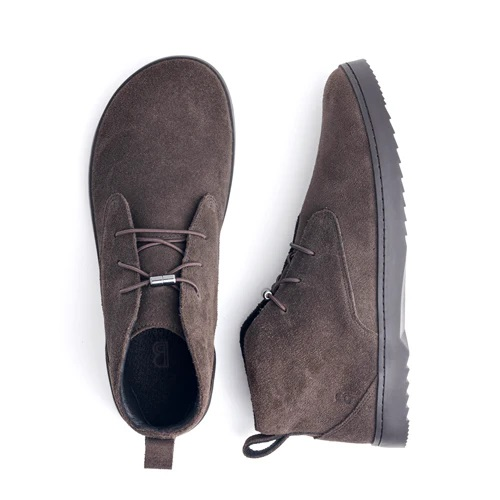
The Carnforth Barefoot Chukka Boot combines a zero-drop sole, wide toe box, and an orthotic-compatible removable insole to address both overpronation and supination. Full-grain American leather, built for real feet.
Strengthening Exercises for Each Pattern
Footwear sets the conditions. Exercises build the capacity. Here's what to focus on based on your pattern.
Exercises for Overpronation
- Short-foot drill (arch activation without toe curling)
- Single-leg calf raises
- Arch lifts
- Tibialis posterior strengthening (resistance band inversion)
Exercises for Supination
- Ankle eversion stretches
- Peroneal strengthening (resistance band eversion)
- Calf stretches, both straight-leg and bent-knee
- Foam rolling the outer calf and IT band
None of these require a gym. 10 minutes a day, consistently, moves the needle.
When to See a Professional
See a podiatrist or sports physio if you have persistent pain, recurring injuries, or no improvement after several weeks of footwear and exercise changes. Footwear and exercises handle most cases. Not all of them.
Conditions like plantar fasciitis and Achilles tendon shortening can have structural causes that no shoe or exercise routine will fully address on its own. A podiatrist or sports physio can run a proper gait analysis, identify what's actually driving the pattern, and rule out anything that needs more targeted attention. Self-assessment gets you started. A professional gets you the full picture.
Prices accurate as of June 2026.
Frequently Asked Questions
How Do I Know If I Overpronate or Supinate?
Check your shoe wear pattern first: inner heel and ball wear points to overpronation; outer edge wear points to supination. Flip over a well-worn pair and look at where the sole has worn down. The wet foot test backs this up: a nearly full footprint suggests overpronation, while a thin strip along the outer edge suggests supination.
What's Worse, Pronation or Supination?
Neither. Both cause real problems when left unaddressed; they just show up in different places. Overpronation tends to stress the arch, inner knee, and ankle. Supination concentrates impact on the outer foot and strains the Achilles. The one that's "worse" is the one you're ignoring.
What Exercises Help with Supination?
Focus on the peroneal muscles along the outer lower leg. Resistance band eversion exercises strengthen them directly. Pair that with calf stretches (both straight-leg and bent-knee) and foam rolling the outer calf. Ankle mobility work helps, too. Consistency matters more than intensity here.
Can the Right Footwear Actually Change How Your Foot Strikes the Ground?
Yes. Footwear shapes the conditions your foot operates in with every step. A shoe with a raised heel pushes the foot into a forward-tilted position that alters your natural strike pattern. A zero-drop sole keeps the foot level, which supports a more natural heel-to-toe movement without forcing it.
Is a Zero-Drop Shoe a Good Choice If You Overpronate?
Yes, for most people. A zero-drop sole encourages the foot to work as designed rather than relying on built-up structure to compensate. Over time, that can help strengthen the arch muscles that overpronation tends to underuse. Transition gradually if you're coming from heavily cushioned shoes, and pair it with the strengthening exercises that support the arch.
Your Feet Already Know What They Need
Overpronation and supination aren't sentences. They're signals. Your foot is telling you something about how it's been moving, and what it needs to move better.
The framework is simple. Know your pattern. Choose footwear that lets your foot do its job instead of overriding it. Add the targeted movement work that builds what's been underused.
Your feet were built for this. Give them the room and the ground feel to prove it.