




Written by Birchbury Team
Most men end up with orthotics the same way. Their feet hurt, a doctor handed them a prescription, and that was that. It made sense at the time. But barefoot shoes operate on a completely different premise: instead of supporting the foot, they train it.
These are two genuinely different philosophies about what feet need. This article breaks down what each approach actually does, where each one works, and what a professional man should weigh before committing to either.
What Orthotics and Barefoot Shoes Actually Do
Orthotics: External Support
Orthotics are shoe inserts that add arch support, correct alignment, or redistribute foot pressure. They compensate for the foot rather than strengthening it. They don't change how your foot works. They change what your shoe does to compensate for it.
The distinction between over-the-counter and custom orthotics matters here. Over-the-counter versions are generic inserts built for an average foot shape — useful for mild issues, but a rough approximation at best. Wait. No em dashes. Let me redo that.
Over-the-counter versions are generic inserts built for an average foot shape. Useful for mild issues, but a rough approximation at best. Custom orthotics are molded to your specific foot by a specialist, which makes them far more precise and considerably more expensive.
Both work on the same principle: add external structure so the foot doesn't have to generate it on its own.
Barefoot Shoes: Internal Strengthening
Barefoot shoes are footwear designed with a zero-drop sole and wide toe box to eliminate artificial arch support and let the foot muscles work naturally. They strip away the arch support, remove the heel lift, and widen the toe box so your toes can spread. The foot muscles do the work. That's the whole point.
Two features define a barefoot shoe: a zero-drop sole, meaning the heel sits at the same height as the forefoot, and a wide toe box that lets toes splay instead of compress. According to a clinical study, this kind of footwear engages foot muscles more actively than conventional shoes.
One approach compensates. The other strengthens. That's the core philosophical split, and everything else in this comparison follows from it.
How Your Dress Shoes Started the Problem
Here's the part nobody tells you at the shoe store. The shoes that sent you to a podiatrist in the first place are almost certainly still on your feet right now.
Most dress shoes have a heel drop of 10–15mm, a toe box built for a tapered silhouette rather than an actual foot, and a sole stiff enough to double as a cutting board. Conventional dress shoes cause three specific biomechanical problems:
- A raised heel shifts your weight forward, shortens the Achilles tendon over time, and disrupts your natural gait
- A narrow toe box compresses your toes together, weakening the intrinsic foot muscles that stabilize every step you take
- A rigid sole prevents the foot from flexing naturally, which means the arch, the heel, and the surrounding tendons absorb load they were never meant to handle alone
The result? Plantar fasciitis, flat feet, overpronation. The exact conditions orthotics get prescribed to treat. The shoes created the problem. The inserts arrived to manage it.
Professional men spend the better part of a workday in these shoes. That's not occasional wear. That's a sustained daily load on a foot that's already being compressed, elevated, and restricted. There's a reason dress shoes actively worsening plantar fasciitis is a documented pattern, not a fringe concern.
A wide toe box and a flat sole aren't luxury features. They're what a shoe looks like when it's not working against you.
The Real Differences That Matter

Support vs. Strength
Orthotics prop up the arch. Barefoot shoes train the muscles underneath it. That's not a subtle distinction. It's the entire argument.
Orthotics work well for conditions like plantar fasciitis and flat feet because they offload stress from structures that are already overworked. The relief is real. The problem is that the foot muscles responsible for generating arch support don't get stronger. They get a break. Permanently.
There's a meaningful difference between resting a muscle and never asking it to work again. Long-term reliance on propping up the arch full-time can create dependency. The foot stops generating support on its own because it never has to.
Barefoot shoes take the opposite bet. Remove the external support, let the foot muscles do the work, and they get stronger over time. That's the theory. The research backs it up.
Short-Term Relief vs. Long-Term Adaptation
Orthotics are fast. Put them in, feel better by afternoon. That's a genuine advantage, especially when you're dealing with acute pain.
Barefoot shoes are slower. The transition takes weeks, sometimes months, as foot muscles adapt to doing work they've been outsourcing for years. Peer-reviewed research published in Scientific Reports found a 57.4% increase in foot strength over six months of minimal footwear use. That's a significant result, but six months is not a quick fix.
The trade-off is straightforward. Orthotics deliver faster relief. Barefoot shoes build more lasting adaptation. Neither is universally better. The right call depends on where your feet are right now and what you're trying to achieve.
The table below summarizes the key differences between orthotics and barefoot shoes across six dimensions.
| Dimension | Orthotics | Barefoot Shoes |
|---|---|---|
| Mechanism | External arch support | Foot muscle strengthening |
| Timeline | Immediate relief | Gradual adaptation (weeks to months) |
| Best for | Acute pain, plantar fasciitis, flat feet | Long-term foot strength and function |
| Dependency risk | Higher with long-term use | Low |
| Cost | $30–$600+ (custom) | One-time shoe purchase |
| Professional appearance | Hidden inside any shoe | Depends on the shoe. Some look sharp, some don't. |
What Most Men Get Wrong About This Decision
Before picking a side, it helps to clear out the bad assumptions. Four common myths lead men to make the wrong footwear decision before they even start.
- Myth: Barefoot shoes are for runners or hippies. Reality: barefoot dress shoes exist and look completely professional. The Brenston is a classic oxford silhouette built on a wide toe box and zero-drop sole. Nobody in the boardroom will know the difference.
- Myth: Orthotics address the root cause. Reality: most orthotics manage symptoms. They don't build the foot strength that created the problem in the first place.
- Myth: You have to pick one permanently. Reality: many men use orthotics for immediate relief while gradually transitioning to barefoot shoes. The two aren't mutually exclusive, especially early on.
- Myth: Barefoot shoes are bad for flat feet. Reality: flat feet often respond well to gradual foot strengthening. The arch doesn't rebuild overnight, but the muscles supporting it can get stronger with consistent work. More on that in what the evidence says about barefoot shoes and flat feet.
The decision isn't as binary as it looks. Most men overcomplicate it by treating it like a permanent commitment when it's really just a starting point.
How to Make the Switch (Without Wrecking Your Feet)
Cold turkey doesn't work here. Your foot muscles have been outsourcing their job for years. Give them too much too fast, and they'll let you know about it. Loudly, around mile two of your commute.
Using Both During the Transition
The practical move is to run both in parallel. Wear barefoot shoes for short stretches, 30 to 60 minutes to start, then increase that window week by week as your intrinsic foot muscles catch up. Keep orthotics in rotation for high-demand days: long meetings, travel, anything where foot fatigue is a real cost.
Three exercises accelerate foot muscle adaptation during the transition to barefoot shoes:
- Toe spreads: press your toes flat and spread them wide, hold for a few seconds, repeat
- Calf raises: slow and controlled, both feet and single-leg
- Single-leg balance: 30 seconds per side, eyes open first, then closed
These aren't complicated. Ten minutes a day builds the foot strength that makes the transition feel like progress instead of punishment.
One caveat: if a specialist diagnosed a structural issue, talk to them before dropping orthotics entirely. This isn't about ignoring professional advice. It's about adding a tool, not throwing one away.
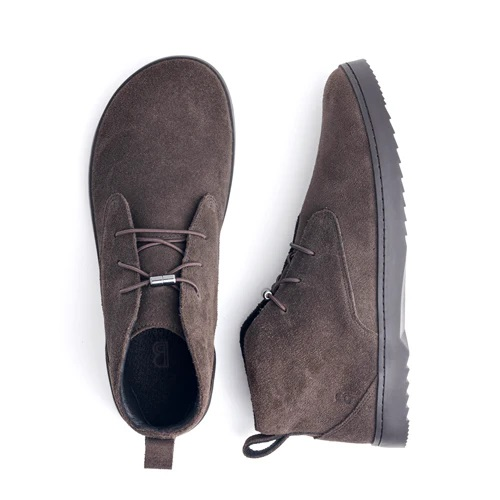
The good news for professional men is that you don't need to show up to work in toe shoes to make this work. The Brenston is a barefoot dress shoe built on a wide toe box and zero-drop sole. It looks like a classic oxford and nobody will question it. If you prefer boots, the Carnforth covers the same ground in a clean chukka silhouette.
Prices accurate as of June 2026.
Frequently Asked Questions
Are Barefoot Shoes Better Than Orthotics?
Neither is universally better. Orthotics work well for acute pain and structural conditions that need immediate offloading. Barefoot shoes build long-term foot strength. The right answer depends on where your feet are right now and what you're trying to achieve.
Do Podiatrists Actually Recommend Barefoot Shoes?
Some podiatrists do recommend barefoot shoes, particularly for patients focused on foot strengthening and long-term function, though it's not yet mainstream.
The research backing it is growing: a clinical study and peer-reviewed research in Scientific Reports both document measurable improvements in foot muscle strength. If your podiatrist hasn't raised it, it's worth asking.
Can You Wear Barefoot Shoes If You Currently Use Orthotics?
Yes. Many men wear both during the transition. Orthotics on high-demand days, barefoot shoes for shorter stretches as the foot muscles adapt. The two approaches aren't mutually exclusive, especially early on.
How Long Does It Take to Transition from Orthotics to Barefoot Shoes?
Expect 3 to 6 months of gradual increase. Start with 30 to 60 minutes a day and build from there. Rushing it is how you end up sore. Patience here is the actual strategy.
Are Barefoot Dress Shoes a Realistic Option for Office Wear?
Yes. The Brenston looks like a classic oxford. Wide toe box, zero-drop sole, full-grain American leather. Nobody in the office will know the difference.
Your Feet Already Know the Answer

For acute foot pain, orthotics provide faster relief. For long-term foot health, barefoot shoes build lasting strength. Both can be used together during the transition. That's not a compromise. It's the smart play.
Orthotics manage symptoms. Barefoot shoes address what's underneath them. Neither is wrong. They're just answering different questions.
The real question is where your feet are right now and where you want them to be in five years. If you're in acute pain, support makes sense. If you're ready to build something more lasting, barefoot shoes are worth the transition.
Professional men don't have to choose between looking sharp and treating their feet well. That was always a false trade-off. Your feet figured that out a long time ago.