
Written by Matthew Tran, Birchbury's Founder
So, do tight shoes cause bunions? Not on their own. They take a bunion your foot structure was already leaning toward and hit the accelerator.
A narrow toe box worn ten hours a day isn't a one-time injury. It's a daily nudge, pressing your big toe joint inward until hallux valgus (the clinical name for that bump) shows up years ahead of schedule. Both halves of the question are true: tight shoes aggravate an existing tendency, and they can push a mild bunion into a painful one.
Bunions come from three places:
- Genetics: the foot shape you were born with
- Wear: years of standing and walking
- Footwear: shoes that make everything worse
More on each in a minute. First, the bump itself.

What a Bunion Actually Is, in Plain Terms
A bunion (hallux valgus, if you want the clinical name) is a joint that changed direction. Your big toe drifts toward the second toe, the first metatarsal (the long bone behind your big toe) drifts the opposite way, and the joint at the base pushes outward.
That bump on the side? Not a growth. Not extra bone glued on. Just your own joint, out of line.
Hallux valgus shows up far more often in women, according to global prevalence data, and it gets more common with age. That skew points to structure and years of load, not shoes alone.
Early on, you'll see redness and a slight angle. Later stages get stiff and hurt in any shoe you own.
How does a joint end up like this in the first place?

The Three Ways Bunions Get Started
Bunions arrive by three routes: inherited foot shape, decades of load, and footwear that narrows the forefoot. Most people are riding at least two of them at once.
Some People Are Born With the Foot Shape for It
Genetics deals the first hand. Any of these tilts the odds:
- A flexible big toe joint
- A longer second toe
- A wider forefoot
- Low arches
Research on inherited foot structure shows hallux valgus runs in families. If your dad has a bump on his foot, your odds go up no matter what you wear. You don't inherit the bunion. You inherit the blueprint for one.
Some Develop Slowly, Over Years of Standing and Walking
Then time does its thing. Decades of miles loosen ligaments. The forefoot spreads.
Weight drifts toward the big toe joint, and the angle creeps a degree at a time. Nobody wakes up with a bunion at 40 that wasn't quietly under construction at 25.
This route explains why unshod populations still get bunions, just at notably lower rates. Feet wear. That part is unavoidable.
And Some Get Pushed Along by Shoes That Are Too Tight
Footwear research links tight shoes and poor shoe fit to faster progression. This is the one route you actually control. A tapered, narrow toe box holds your big toe at an angle for ten hours a day, and the joint learns that position.
Width isn't the only culprit, though. Heel elevation matters just as much.
Even a modest dress shoe heel, an inch or so, slides your toes forward into the narrowest part of the shoe. High heels combine both problems, which is why they show up in bunion study after bunion study.
The daily offender for office workers isn't the weekend sneaker. It's the dress shoe that never leaves room for your toes to splay.
One more bump deserves a mention before the shoe advice.

Tailor's Bunion Is the Same Story on the Other Side of Your Foot
A tailor's bunion, or bunionette, is the same misalignment at the fifth metatarsal, where your pinky toe meets your foot. The big toe doesn't have a monopoly on this. Same mechanism, opposite direction: pressure pushes the little toe inward and the joint out.
The story goes that the name comes from tailors who sat cross-legged all day with the outside edge of the foot on the floor. Modern version? Constant pressure on the fifth toe from a narrow toe box that squeezes from both sides, which is why some people get both bumps at once.
Watch for:
- A hot spot on the outside edge of your foot
- A callus where the pinky toe meets the foot
- A hole worn clean through the side of your shoe
Shoes take plenty of blame, but they have accomplices.

Other Things That Stack the Odds Against Your Big Toe
Five other factors can tilt the odds:
- Old foot injuries, especially to the forefoot or big toe joint, which change how the joint tracks under load
- Inflammatory arthritis, which changes how the joint holds its shape
- Pregnancy, where hormones and added load loosen ligaments
- Jobs that keep you on hard floors all day, which pile constant load onto the forefoot
- Flat feet and overpronation (the foot rolling inward as you walk), which shift load onto the first metatarsal
One rule cuts through all of it: if the bump is painful, stiff, or changing fast, see a podiatrist. Not a comment section. And to be clear, this article is information, not medical advice.
Short of the doctor's office, your shoe rack is where you have the most control.

What to Look for in Shoes If You Want to Stop Making It Worse
Now that you know the mechanism, shopping gets simple. Shoes that slow the damage share four traits: a wide toe box, a zero-drop sole, a flexible forefoot, and a real fit check. You're filtering for one thing: toes that get to sit where nature put them.
The Four Things That Actually Matter in a Shoe
- Wide toe box: one that stays wide at the very front, not one that tapers to a point
- Zero-drop sole (heel and forefoot at the same height), so your weight doesn't tip forward into the narrowest part
- Flexible sole: it lets your forefoot spread under load instead of fighting the shoe
- Real shoe fit: length, width, and depth, since most men size by length alone
The sizing guide covers the last one. The rest you can check right at home.
How to Check Whether a Shoe Fits Your Toe Splay at Home
Toe splay is the natural spread of your toes under load. Here's the 30-second test for whether a shoe allows it:
- Pull the insole out.
- Stand on it barefoot.
- Look down. Toes hanging over the edges? That shoe is a narrow toe box in disguise.
One honest caveat: roomier shoes and toe spacers can take pressure off and make walking more comfortable. They don't undo the joint angle.
As for shoes that check all four boxes, we make two.
Two Pairs Built Around Toe Room Instead of a Pointed Silhouette
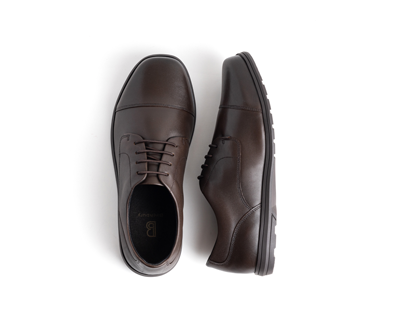
Birchbury's Brenston looks like a classic oxford but hits every criterion:
- Wide toe box
- Flat zero-drop sole
- Handcrafted in soft full-grain American leather
- No break-in period
- Removable insole that works with custom orthotics
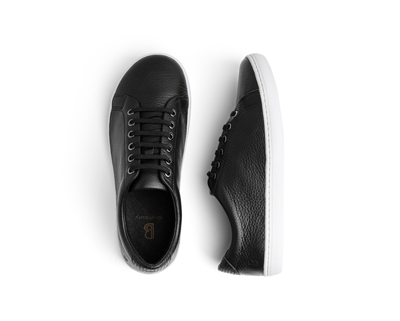
Off the clock, the Bramford is the leather sneaker version of the same idea, with elastic no-tie laces. Same wide toe box, same flat sole. Brenston for the office, Bramford for everything else.
That's the whole playbook.
Your Feet Are Not the Problem, the Shape of the Shoe Is
The short version:
- A bunion is a joint misalignment, not a growth
- Genetics sets the risk, and years of wear build on it
- Footwear controls the pace
- Roomy shoes slow the trip, but they don't reverse it
You didn't cause your bunion. Your genes drew the map, and the years walked it. Still, you get a vote in how fast the trip goes, and the ballot is shaped like a wide toe box.
The choice between looking sharp and letting your toes sit flat was always a false one. Somebody just kept building shoes shaped like arrowheads.
Give your toes room now, or your feet will file a complaint later. They always do.
Questions People Ask About Bunions and Shoe Fit
1. Can you get bunions from wearing shoes?
Wearing narrow, tapered shoes alone does not create a bunion out of thin air, but it is the primary catalyst that accelerates and worsens the deformity.
While genetic foot anatomy provides the underlying predisposition, cramming your big toe inward inside tight toe boxes forces the metatarsophalangeal joint out of alignment over time, which then leads to bunions.
2. What is the biggest cause of bunions?
The biggest cause of bunions is a combination of inherited foot mechanics and prolonged exposure to restrictive footwear. Genetics dictate your bone structure, ligament flexibility, and arch stability, which makes your foot prone to joint shifting. And wearing pointed shoes and elevated heels acts as the trigger, driving the big toe inward and accelerating the misalignment across hundreds of walking hours.
3. What is the best treatment for bunions?
The best non-surgical treatment is immediately switching to shoes with a wide toe box and a flat, zero-drop sole to eliminate pressure across the forefoot. Pairing foot-shaped shoes with toe spacers, intrinsic foot strengthening, and soft protective insoles halts progression and relieves chronic inflammation.
While surgery is the only method to physically reset the bone, proactive footwear changes successfully keep most people pain-free without an operation.
4. What types of shoes are best for people with bunions?
Among the best types of shoes for people with bunions are barefoot shoes like Birchbury. Because these shoes feature an anatomically wide toe box that allows the big toe to sit straight without pressing against the sidewalls.
They also incorporated a zero-drop platform, which keeps your body weight evenly distributed across the entire foot instead of dumping load onto the ball of the foot. And to further elevate the comfort, Birchbury shoes are made from soft full-grain leather that conform to the bunion rather than rubbing against it.
5. What brand of shoes are best for bunions?
The best brand depends on where you need to wear them. For professional, smart casual, and formal settings, Birchbury is a top-rated choice because its foot-shaped toe box and soft American full-grain leather accommodate bunions comfortably while looking like classic dress shoes.
For athletic training, trail running, or casual gym workouts, brands like Lems, Altra, and Vivobarefoot offer great foot-shaped alternatives.
6. Where can I find custom shoes for bunions?
You can visit a local bespoke shoemaker or pedorthist to have your feet measured for a pair that will not aggravate your bunion. However, custom builds often take weeks or months to craft and can be very expensive.
If you want immediate relief, you can opt for foot-shaped barefoot shoes like Birchbury, which are engineered with a wide toe box and supple American full-grain leather to deliver all-day comfort for existing bunions right out of the box.

Matthew Tran
Founder, Birchbury
Matthew Tran is a mechanical engineer who founded Birchbury. He started the company after struggling to find dress shoes that didn’t hurt — and barefoot shoes that didn’t look out of place at work. That gap led him to design his own: a wide-toe-box, zero-drop shoe made from full-grain leather, built specifically to look like a normal shoe. Birchbury has since been worn by lawyers, chiropractors, restaurant managers, and anyone else who spends their day on their feet and refuses to suffer for it.
More about Matthew Tran →