
Quick answer: barefoot shoes win at a standing desk if you want stronger feet and better posture over long sessions. Cushioned shoes win if you want instant softness and nothing more.
The catch: foam absorbs shock but mutes the feedback your feet send upstairs. You don't notice fatigue until it's a problem.
Barefoot shoes flip that. Zero-drop soles keep your heel and forefoot level, so your feet do the work instead of the foam.

Here's the side-by-side:
| Feature | Barefoot Shoes | Cushioned Shoes |
|---|---|---|
| Sole type | Thin, flexible, zero-drop | Thick foam, elevated heel |
| Arch support | None; your arch does the job | Built-in structure |
| Shock absorption | Minimal; you adjust naturally | High; foam takes the hit |
| Toe box width | Wide, toes splay freely | Typically tapered |
| Best use case | Long standing, foot strength | Short bursts, instant comfort |
There's no universal winner here. The verdict depends on what you're optimizing for: long-term foot health or comfort in the next five minutes.
That distinction matters more than most people realize. Eight hours of standing still is a different beast than walking, and your shoes should account for it.

Key Differences Between Barefoot and Cushioned Shoes for Standing Desks
Barefoot and cushioned shoes differ in three main ways: sole structure, toe box width, and arch support. The gap isn't marginal. They're built on opposite philosophies, and your feet notice the difference by hour three.
Sole Structure and Ground Feel
Cushioned shoes reduce ground feel by putting a thick slab of foam between you and the floor. Comfortable at first. The trade-off: foam mutes proprioception, the feedback system your feet use to sense position and pressure.
Barefoot shoes take the opposite bet. Zero-drop soles keep your heel and forefoot on the same plane, so your foot muscles handle stability instead of a built-up midsole.
Balance research suggests that richer ground feel helps the body make small, constant postural corrections. Bare feet work the same way. Barefoot shoes just add a layer of protection to the deal.
Toe Box Width and Natural Toe Splay
A narrow toe box (the front section of the shoe where your toes sit) reduces your stability by squeezing your toes together and shrinking your base of support. Tapered toe boxes do exactly that, quietly sabotaging you from the front.
A wide toe box lets your toes splay, and that changes your weight distribution:
- Pressure spreads across the whole forefoot instead of piling onto a few points
- Your big toe can actually push into the ground and stabilize you
- A wider base means less wobble during long static standing
Arch Support: Built-In Versus Self-Trained
Cushioned shoes provide built-in arch support, while barefoot shoes leave your own arch muscles to do the job. This is where the philosophies split hardest. The built-in structure is there whether your arch needs it or not.
Barefoot shoes hand the work back to your arch muscles. That takes time to develop, no question. One approach rents you support. The other trains you to own it.
What Happens to Your Feet During Prolonged Standing
Shoes matter, but they're only part of the equation. Prolonged standing stresses your body in ways no sole design fully cancels out, whether it's foam, leather, or an anti-fatigue mat underfoot.
Minimal shoes do offer one clear edge here. Stand in them and you get more proprioceptive feedback, which keeps you aware of your posture instead of slowly slumping into your hips by hour four. Awareness is half the battle.

The 20/8-2 Rule for Standing Desk Posture
The other half is movement. The 20/8-2 rule: stand 20 minutes, sit 8, walk 2. It's a commonly recommended rule of thumb, not settled science, and it cycles through three phases every 30 minutes:
- 20 minutes standing at your desk
- 8 minutes sitting or shifting position
- 2 minutes walking or stretching
That rotation cuts foot fatigue no matter which shoes you wear. Static posture is the real culprit, not just your footwear choice.
Don't overcorrect into a chair all day, though. The chair brings its own baggage, and how sitting all day changes your feet is a story worth knowing before you retire the standing desk.
Foot Fatigue and Blood Flow During an 8-Hour Shift
Prolonged standing raises ankle blood pressure and calf muscle blood flow regardless of shoe type. That's the finding of a physiological study, and it explains that heavy-leg feeling at the end of a shift.
Foam and shock absorption can't outrun physiology. The NIOSH bulletin on standing points to movement breaks and posture changes as the reliable fatigue reducers.
In practice, that means footwear is one lever among several. Pull all of them, and eight hours upright stops feeling like punishment.
Why Do Podiatrists Push Back on Barefoot Shoes?
Some podiatrists push back because barefoot shoes strip away structural support that certain feet lean on. Not every foot is ready to stand on its own. Especially not after decades in supportive footwear.
What the Skepticism Is Really About
Dig into the criticism and you'll find it's narrower than it sounds. The worry isn't the category. It's the transition.
The pushback centers on two specific issues:
- Limited long-term research. From what's published so far, large-scale studies on years of barefoot shoe use are thin, so skeptics hedge.
- Rushed transitions. Feet accustomed to arch support need time to build strength. Skip that adaptation and you invite trouble, particularly for certain foot conditions.
Think of standing barefoot as a skill your feet relearn gradually. Rush it, and you prove the skeptics right.
Why Cushioned Brands Like Skechers Get Criticized Too
Before you assume foam gets a free pass, it doesn't. Skechers earns real credit for instant comfort. The soft landing is genuine, and plenty of people love it.
The critique: soft cushioning can mask fatigue rather than prevent it. Soft isn't the same as supportive, and foam that feels stable without being stable lets your feet ache anyway after a full day of standing.
Neither side holds a settled verdict. This is a live debate, and honest footwear brands admit it.

How to Transition to Barefoot Shoes for All-Day Standing
The skeptics have a point about rushing. So don't rush. A smart transition plan turns barefoot shoes from a gamble into a gradual upgrade, and it takes less discipline than you'd think.
The Transition Timeline: What to Expect
Plan on roughly 2 to 4 weeks to adjust to standing all day in minimalist shoes. Not because the shoes are hard to wear. Because your stabilizing muscles have been on vacation.
Start with a few hours at your desk, then switch back to your usual pair. Add an hour or two every few days. Your feet will tell you when to push and when to hold.
The adjustment usually plays out like this:
- Week 1: sore calves and arches. Normal. The small muscles that handle standing barefoot are waking up.
- Weeks 2 to 4: the soreness fades as those muscles start pulling their weight.
- Past a month: still wrecked? Slow down. Lingering foot fatigue means you scaled up too fast.
Adaptation isn't a race.
The 3 Shoe Rule for Rotating Your Footwear
The trick that makes the timeline painless: the 3 shoe rule. It means rotating between three pairs across the week so no single pair takes 100% of the daily load.
The rotation might look like this:
- Monday and Thursday: your barefoot pair
- Tuesday and Friday: your current cushioned pair
- Wednesday: a third comfortable option
Your feet get recovery days built into the schedule. Your shoes benefit too. Rotation gives leather and materials time to air out and recover their shape between wears, which stretches the life of every pair.
Three shoes. One transition. Zero drama.
Barefoot Shoe Options Built for Standing Desks
Theory only gets you so far. At some point you need actual shoes on actual feet, and Birchbury builds two specifically for long hours at a standing desk.

Everyday Standing: The Bramford Sneaker
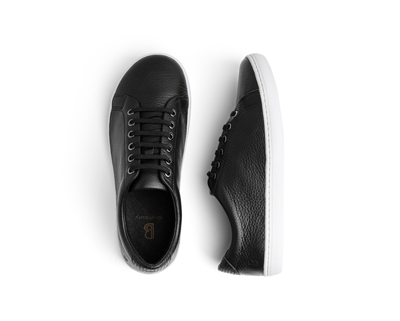
The Bramford ($120) is a zero-drop leather sneaker with a wide toe box and a removable insole, built for all-day standing with no break-in period. You wear it on day one and stand in it on day one.
The wide toe box lets your toes splay, so pressure spreads across your whole forefoot instead of piling onto a few points during long static stretches. No built-in arch support, no thick cushioning. Your feet handle the job, exactly as the earlier sections argued they should.
The flat, flexible sole holds up on concrete and other hard floors, which is why it shows up in our guide to the best shoes for standing on concrete all day.

Office Standing: The Brenston Dress Shoe
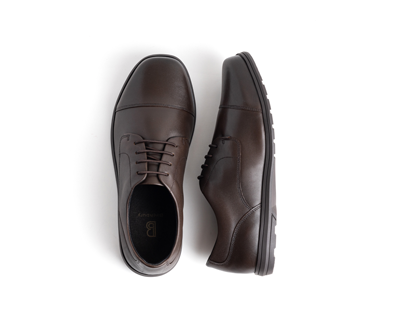
The Brenston ($180) takes the same formula and hides it inside a classic oxford silhouette. Same wide toe box. Same flat sole. It just happens to look right under a suit.
Both shoes share a few details worth knowing:
- American full-grain leather, soft out of the box and handcrafted to hold up
- Elastic no-tie laces for quick slip-on during a workday
- Removable insoles if you want to adjust the fit
Sizing note: Birchbury runs true to size and offers no half sizes, with one exception, size 11.5. Between sizes? Size up and let the wide toe box do its thing.
Shop the Brenston barefoot dress shoe with a wide toe box →
Common Questions About Barefoot and Cushioned Shoes for Standing Desks
The same questions come up every time this debate does. Quick answers, no runaround.
Who Should Not Wear Barefoot Shoes?
People with significant existing foot pain should not switch to barefoot shoes cold. Ease in slowly instead, and a chat with a foot specialist first is worth the copay. Healthy feet adapt on schedule; hurting feet need a gentler on-ramp.
Can I Use an Anti-Fatigue Mat With Barefoot Shoes for Extra Comfort?
Yes, and the pairing works better than you'd expect. The anti-fatigue mat absorbs some floor-level impact while the shoe still lets your foot move and splay naturally, so you get softness underfoot without surrendering ground feel.
What Shoes Are Best for Standing Desks?
The best standing desk shoes share two traits: a flat, stable sole and enough width up front for your toes to spread naturally, whether the design leans barefoot or cushioned. The Bramford checks both boxes in a handcrafted leather sneaker that works at a desk or anywhere else.
Try the Bramford barefoot leather sneaker for everyday standing comfort →
Are Barefoot Shoes Better for Standing?
Yes, over the long run. Barefoot shoes tend to support standing posture and build foot strength across months of use, while cushioned shoes deliver more immediate impact absorption but do less to hold off foot fatigue as the years stack up.
Which Shoe Actually Wins at the Standing Desk?
The honest answer: whichever matches what you're optimizing for.
Pick cushioned shoes if you want softness right now. Foam absorbs shock from minute one and asks nothing of your feet. Fair choice while your stabilizing muscles catch up during a transition.
Pick barefoot shoes if you want natural posture, free toe splay, and real ground feedback. The trade is a few weeks of easing in. The payoff is feet that carry you instead of foam that carries your feet.
Either way, shoes are one lever. An anti-fatigue mat, posture rotation, and movement breaks do work no sole can replace.
Strong feet, smart habits, and a shoe that respects both. That's the winning combination.
Prices accurate as of July 2026.

Matthew Tran
Founder, Birchbury
Matthew Tran is a mechanical engineer who founded Birchbury. He started the company after struggling to find dress shoes that didn’t hurt — and barefoot shoes that didn’t look out of place at work. That gap led him to design his own: a wide-toe-box, zero-drop shoe made from full-grain leather, built specifically to look like a normal shoe. Birchbury has since been worn by lawyers, chiropractors, restaurant managers, and anyone else who spends their day on their feet and refuses to suffer for it.
More about Matthew Tran →