
Key Takeaways
- Loafers, derbies, Chelsea boots, chukkas, and minimal sneakers all work for business casual, but material and construction matter as much as the style.
- A wide toe box and zero-drop sole aren't just comfort extras: narrow, elevated designs can contribute to bunions and nerve irritation over time.
- A 2024 Forbes study links shoe comfort to workplace performance, making footwear choice a practical decision, not just a style one.
- Brown leather reads as more versatile than black for most business casual outfits, as long as the formality still matches the rest of the look.
Written by Matthew Tran, Birchbury's Founder
Business casual is now the default dress code in most offices, yet it's the dress code that trips men up most. The shoes are usually where things go wrong. Pick something too formal and the outfit looks stiff. Go too casual and you undermine the whole look. Land somewhere in the middle with the wrong pair and you're limping to your car by 3 p.m.
This guide covers men's business casual shoes worth knowing about, the construction features that separate a long day from a comfortable one, and the picks that hold up on both counts.
Table of contents:
- Best Types of Business Casual Shoes for Men
- What to Look For in Business Casual Shoes
- What Poorly Fitting Business Casual Dress Shoes Do to Your Feet
- Our Top Picks for Business Casual Comfort
- How to Go From Formal Shoes to Business Casual Without Looking Sloppy
- FAQs

Best Types of Business Casual Shoes for Men
The five best types of business casual shoes for men are loafers, derby shoes, Chelsea boots, chukka boots, and clean leather sneakers. Business casual dress codes have been evolving dress codes for years, and the shoe options that qualify have expanded along with them. The five styles below cover the full range, from the most relaxed offices to those that lean closer to traditional professional.
Loafers
Loafers are the most versatile business casual shoe a man can own. A classic penny loafer in leather or suede pairs equally well with chinos, wool trousers, or dark denim. There's no lacing to fuss with, and the silhouette reads as polished without trying too hard. Suede loafers work particularly well in warmer months when a lighter, breathable shoe makes more sense.
Derby Shoes
Derby shoes are a mid-formality leather shoe that sits between a sneaker and a traditional oxford. They're cleaner and more refined than sneakers, but less rigid in formality than a traditional oxford. That makes them a strong choice for offices that sit somewhere between relaxed and professional. Some derby styles include brogue detailing, which adds visual texture without pushing the shoe into formal territory.
Chelsea Boots
Chelsea boots are a slip-on leather boot with an elastic side panel, well-suited to business casual dress codes from fall through spring. The elastic side panel gives them a sleek, unbroken silhouette that pairs well with trousers and chinos alike. They read as intentional and put-together without requiring much effort. A leather Chelsea in black or tan covers most office environments comfortably.
Chukka Boots
Chukka boots are ankle-height leather boots with two or three eyelets, positioned between a dress shoe and a rugged boot in formality. That makes them adaptable across a wide range of office environments. A leather chukka in tan or brown works through fall and winter, and the low ankle height keeps the silhouette from feeling too heavy.
Clean Sneakers
Minimal leather or suede sneakers can qualify as business casual when they have a thin sole, no athletic branding, and a simple silhouette. The upper needs to be leather or suede, the sole should be thin and low-profile, and there should be no athletic branding or chunky cushioning. A white or neutral leather sneaker with a simple silhouette reads as intentional. Running shoes and training shoes do not qualify, regardless of how clean they look.
Across all five categories, the material and construction matter as much as the style. A well-made leather shoe in any of these silhouettes will carry a business casual outfit. A poorly constructed one, regardless of how it looks on the shelf, tends to show its limits by midday.

What to Look For in Business Casual Shoes
Comfort and Fit
A wide toe box allows your toes to spread naturally, reducing the pressure that builds up during a long office day. Most dress shoes skip this — their narrow, tapered toe boxes look refined on the shelf but compress your toes within hours of wear.
If you've ever found yourself shifting your weight or loosening your laces by early afternoon, the fit is the problem, not your feet. Getting the fit right from the start matters more than most men realize. If you want to understand how foot comfort at work connects to shoe construction, the details are worth reading before you buy.
Materials That Hold Up
Full-grain leather is the standard worth measuring everything else against. It develops a patina over time, holds its shape through daily wear, and breaks in to the shape of your foot rather than breaking down. Suede is a strong alternative for less formal offices. It has a softer, more relaxed look that works well with chinos and casual trousers, though it requires more maintenance and doesn't handle wet weather as well.
Color plays a practical role here too. Brown leather is the most versatile choice for business casual. It pairs naturally with navy, grey, and earth tones, and reads as polished without being stiff. Black leather skews more formal and works better in offices that lean toward traditional professional dress.
Sole Design and Support
A zero-drop sole — where the heel and forefoot sit at the same height — is the most important sole feature for all-day comfort in business casual shoes. It puts your foot in a more natural position throughout the day. Traditional dress shoes raise the heel, which shifts your weight forward and can create strain across the lower body over time. A flat, minimalist sole avoids that without sacrificing the clean profile a business casual shoe needs.
A thinner sole with a foot-shaped last tends to feel better across a full day of wear. Thick, cushioned soles can seem like the comfortable choice, but they often interfere with natural foot movement.

What Poorly Fitting Business Casual Dress Shoes Do to Your Feet
Most men accept foot discomfort as part of wearing dress shoes. By the end of a long workday, sore toes and tight arches feel like the price of looking professional. That's worth questioning, because the discomfort isn't random. It has a cause.
Narrow toe boxes are the most common culprit. When your toes are compressed for hours at a time, the pressure doesn't just cause temporary soreness. Over months and years, that repeated compression can contribute to conditions including:
- Bunions
- Hammertoes
- Nerve irritation
These aren't dramatic outcomes. They develop gradually, which is exactly why most men don't connect them to their footwear until the problem is well established.
Elevated heels create a different set of issues. When your heel sits higher than your forefoot, your weight shifts forward and your body compensates through the ankles, knees, and lower back. That compensation is subtle on any given day, but it adds up. A 2024 Forbes analysis found that style choices — including footwear — directly affect workplace performance, with physical comfort playing a larger role than most employees recognize.
Barefoot shoe design addresses both problems directly. A wide toe box gives your toes room to spread naturally. A zero-drop sole keeps your heel and forefoot level, which removes the forward weight shift entirely. The result is a shoe that works with your foot rather than against it.
Our Top Picks for Business Casual Comfort
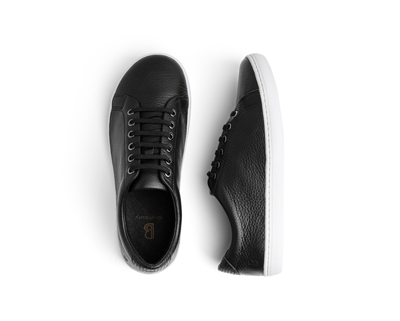
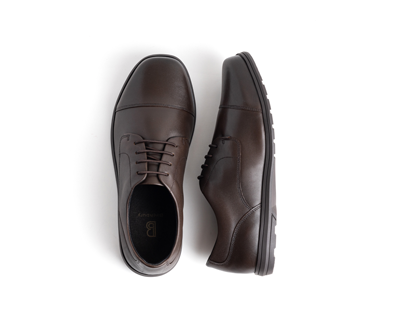
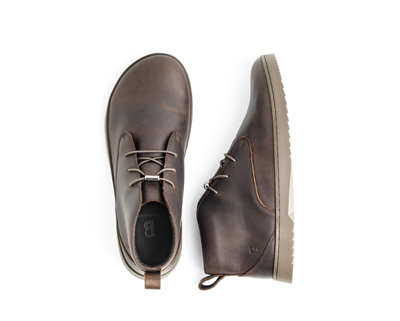
Three picks cover most business casual scenarios: Best dress shoe: Birchbury Brenston ($180) | Best boot: Birchbury Carnforth ($197) | Best sneaker: Birchbury Bramford ($120). All three share the same core construction: wide toe box, zero-drop sole, and full-grain American leather. What changes is the silhouette.
Best Dress Shoe: Birchbury Brenston
The Birchbury Brenston is a barefoot dress shoe priced at $180, rated 4.5 stars from 612 reviews on the product page, and best suited for formal office environments and client-facing roles. It looks exactly like a classic oxford. The difference is what's inside. A wide toe box gives your toes room to spread naturally, and the zero-drop sole keeps your heel and forefoot level throughout the day. The upper is built from soft full-grain American leather that molds to your foot without a painful break-in period.
The Brenston also includes a removable insole, so it accommodates custom orthotics if you use them. It's the pick for formal meetings, client presentations, or any office environment where a polished leather shoe is expected.
It pairs well with a suit or with dark denim. Either way, the minimalist design reads as intentional without drawing attention to itself.
Best Boot: Birchbury Carnforth
The Birchbury Carnforth is a barefoot chukka boot priced at $197, rated 4.4 stars from 317 reviews on the product page, and best suited for cooler months and outdoor commutes. It's built for the gap between dress shoes and rugged boots. It carries the same wide toe box and zero-drop sole as the Brenston, wrapped in full-grain American leather with water-resistant treatment. That last detail matters more than it sounds during fall and winter commutes.
Like the Brenston, the Carnforth includes a removable insole for custom orthotics. It's the right pick for cooler months, outdoor commutes, or offices where chukka boots fit the dress code. The low ankle height keeps the silhouette clean, and the leather softens with wear rather than stiffening up.
Best Sneaker: Birchbury Bramford
The Birchbury Bramford is a barefoot leather sneaker priced at $120, rated 4.6 stars from 1,006 reviews on the product page, and best suited for casual Fridays and relaxed office environments. It's a clean, minimal leather sneaker built on the same barefoot principles as the rest of the lineup. Soft leather upper, wide toe box, zero-drop sole, and elastic no-tie laces that make it easy to slip on. The removable insole fits custom orthotics.
Nobody will mistake the Bramford for a running shoe. The silhouette is minimal enough to work with chinos or dark denim without looking out of place.
These three cover most business casual scenarios on their own. For the full range of styles, the office-ready shoe lineup includes additional options across silhouettes and colorways.

How to Go from Formal Shoes to Business Casual Without Looking Sloppy
To transition from formal to business casual shoes, swap oxfords for loafers or derby shoes, and shift from black leather to brown. The change doesn't require a completely different wardrobe — it mostly comes down to swapping one silhouette for another and adjusting your color choices to match the outfit.
Start with the shoe style. Oxfords are the most formal leather shoe you can wear, which makes them feel stiff in relaxed office environments. Swapping to derby shoes or loafers keeps the same level of polish while reading as more approachable. Both work with chinos, wool trousers, and dark denim without looking like you forgot to change after a board meeting.
Color matters more than most men account for. Black leather reads as formal. Brown leather is the more natural fit for business casual settings. A brown leather loafer or derby in a clean, simple silhouette covers roughly 90% of business casual situations without any second-guessing.
Quick Rules for Business Casual Shoe Pairing
- Pair leather shoes with wool trousers for a more polished look
- Boots and clean leather sneakers work better with chinos
- Brown or tan leather suits most business casual environments
- Avoid athletic sneakers, heavy work boots, and anything with thick lug soles
The goal is to match shoe formality to outfit formality. When those two are aligned, the rest of the look takes care of itself.
Prices accurate as of April 2026.
FAQs
1. What are considered business casual shoes for men?
Business casual shoes for men bridge the gap between formal oxfords and casual weekend footwear, typically including derbies, loafers, chukka boots, and clean, minimalist leather sneakers. These styles pair seamlessly with chinos, dress trousers, or dark denim while avoiding the rigid stiffness of traditional black-tie footwear. For the best daily comfort, look for options crafted with soft full-grain leather and flexible outsoles that can handle long hours on your feet.
2. Are dress shoes appropriate for business casual?
Yes, dress shoes like derbies, brogues, and clean cap-toe styles are entirely appropriate for business casual settings, especially when paired with tailored trousers or dark denim.
If you want a comfortable pair for long workdays, the Birchbury Brenston is highly recommended because it provides a classic cap-toe dress silhouette on the outside while featuring an anatomically wide toe box, supple American full-grain leather, and a flat zero-drop sole on the inside.
3. What is not allowed in business casual?
Footwear that is strictly not allowed in business casual includes athletic gym trainers, running shoes with loud neon colors, flip-flops, sandals, and dirty or heavily distressed sneakers. You should also avoid ultra-casual canvas slip-ons and heavy, muddy work boots, as both undermine the clean, professional aesthetic of your trousers or chinos.
4. Can I wear Nike sneakers for business casual?
Yes, you can wear select low-profile Nike sneakers, but prominent logos, bulky midsoles, and sporty synthetic fabrics can easily clash with tailored trousers and make an outfit look too athletic.
If you want sleeker sneaker shoes for business casual that effortlessly elevates your attire, the Birchbury Bramford is highly recommended because it eliminates loud branding, uses premium American full-grain leather, features an anatomically wide toe box, and comes in versatile colorways to match any workplace wardrobe.
5. Are chukka boots considered business casual?
Yes, chukka boots are widely considered one of the most versatile business casual shoes for men. Their clean ankle-high profile and open lacing pair naturally with chinos, corduroys, and tailored jeans. Choosing a foot-shaped pair like the Birchbury Carnforth gives you that refined boot aesthetic along with the all-day comfort of water-resistant American full-grain leather and a wide toe box.
6. Are loafers business casual?
Yes, loafers are considered a quintessential business casual shoe for men. Classic styles like penny loafers, tassel loafers, and horsebit loafers in full-grain leather or suede pair effortlessly with chinos, tailored trousers, and dark denim.

Matthew Tran
Founder, Birchbury
Matthew Tran is a mechanical engineer who founded Birchbury. He started the company after struggling to find dress shoes that didn’t hurt — and barefoot shoes that didn’t look out of place at work. That gap led him to design his own: a wide-toe-box, zero-drop shoe made from full-grain leather, built specifically to look like a normal shoe. Birchbury has since been worn by lawyers, chiropractors, restaurant managers, and anyone else who spends their day on their feet and refuses to suffer for it.
More about Matthew Tran →