
Key Takeaways
- Traditional dress shoes hurt because their narrow toe box cramps your toes.
- Cramped toes can't spread to help you balance. Making it much easier to fall.
- Raised heels in dress shoes are not worth the extra height. They tilt your pelvis forward, forcing your lower back to arch. This strains your hips, knees, and back.
- The solution is barefoot dress shoes. They have a wide toe box and a zero-drop heel while still meeting the office dress code.
Written by Matthew Tran, Birchbury's Founder
If you have ever asked, "Why are dress shoes so uncomfortable?" You are not alone.
Most professionals assume aching feet are simply the price of looking sharp.
However, dress shoes don't hurt because you picked the wrong pair or “it’s just how dress shoes are”.
They hurt because traditional shoemaking forces human feet into unnatural triangular toe boxes.
The Hidden Damage of the Standard Dress Shoe
Human feet are naturally widest across the toes. But standard dress shoes completely ignore this basic biology.
That’s why they taper towards the toes and squeeze them into an artificial point.  Here’s where the problem begins:
“Current data suggests that footwear that fails to respect natural foot shape and function will ultimately alter the morphology and the biomechanical behaviour of the foot" (D'Août et al., 2009).
This means that when they are cramped together, your toes lose their natural ability to spread evenly and balance your weight.
Additionally, “the use of conventional modern shoes is associated with weaker intrinsic foot muscles that may predispose individuals to reduced foot stiffness and potentially flat foot” (Holowka et al., 2018).
Over time, this compression weakens your arch muscles.
It even places severe, unnatural pressure on delicate joint capsules in your feet.
This continuous squeeze accelerates painful structural deformities on your feet, like bunions, which often require invasive surgery down the road.
 Another damaging feature of traditional dress shoes is their elevated heels. “Wearing heels causes your lower back to arch more than normal because your body weight is being pushed forward. Your hips shift forward” (Wagenheim, 2019).
 These hidden health hazards made me realize that modern dress shoes are essentially ENGINEERED TORTURE DEVICES.
Yet millions of men and women endure this daily pain simply to meet a workplace dress code.
This inspired me to begin my mission to fundamentally redesign everyday leather footwear from the ground up.
 The goal? Make them more comfortable, but keep ‘em CLASSY.
Re-Engineering the Dress Shoe: How the Birchbury Brenston Solves the Pain
Eliminating chronic foot pain does not mean you have to wear odd-looking and unappealing barefoot shoes.
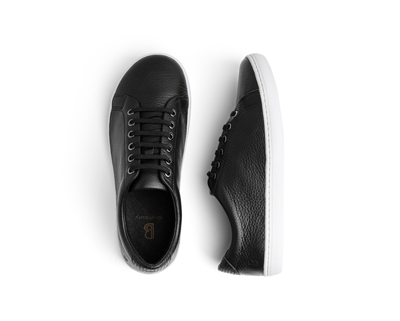
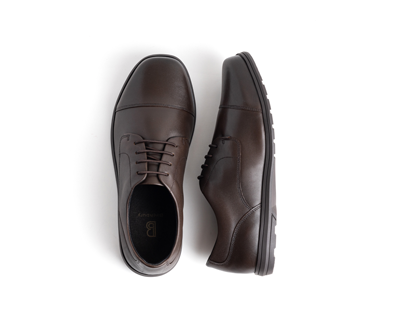
At Birchbury, we engineered our flagship Brenston dress shoe to solve the structural flaws of traditional footwear without sacrificing sharp aesthetics:
 The classy wide toe box: We designed a shoe that gives your toes generous room to spread naturally. This restores blood circulation and relieves joint pressure all day, while keeping a sleek shape on the outside.
 Supple American Full-Grain Leather: Traditional dress shoes require weeks of blister-inducing break-in time. We craft our shoes using premium American full-grain leather that flexes naturally with your foot right out of the box.
 The Faux Heel Illusion: The internal sole is completely flat (zero-drop) so your spine and pelvis align naturally. Outside, a subtle faux heel ensures you look completely at home in formal settings.
By embedding these smart engineering directly into our entire line of handcrafted leather shoes, you get all-day joint relief disguised in a sharp profile that blends into the crowd.
What Happens When You Stop Torturing Your Feet at Work
Most people don't realize how much mental energy they waste dealing with uncomfortable dress shoes.
You find yourself kicking them off under your desk. You dread walking across the building or standing during long meetings.
And by the time you head home, your feet feel completely beat up.
But when you wear shoes that let your toes spread and your heels sit flat, the whole experience changes.
Once your feet experience that kind of freedom, slipping back into stiff, narrow footwear feels impossible:
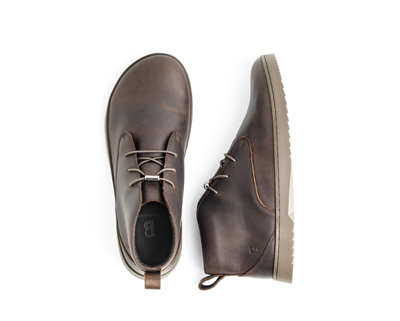
 You don’t have to sacrifice your long-term joint health just to look professional at work. If you’re ready to eliminate daily foot pain, you can explore Birchbury's full lineup of barefoot dress shoes, sneakers, and boots risk-free with 30-day free returns and exchanges.
References
- D'Août, K., Pataky, T. C., De Clercq, D., & Aerts, P. (2009). The effects of habitual footwear use: Foot shape and function in native barefoot walkers. Footwear Science, 1(2), 81–94. https://doi.org/10.1080/19424280903386411
- Holowka, N. B., Wallace, I. J., & Lieberman, D. E. (2018). Foot strength and stiffness are related to footwear use in a comparison of minimally- vs. conventionally-shod populations. Scientific Reports, 8(1), Article 3679. https://doi.org/10.1038/s41598-018-21916-7
- Wagenheim, A. D. (2019, May 10). The high price of high heels: My day in heels. UPMC HealthBeat. https://share.upmc.com/2019/05/how-high-heels-affect-your-health/
Health Disclaimer:
- The product does not constitute medical advice and is not intended to diagnose, treat, cure, or prevent any disease. The product is not a substitute for medication or other treatment prescribed by a physician or health care provider. If you are pregnant, breast feeding, taking medication, or under medical supervision, please consult a doctor or healthcare professional before use.
- The U.S. Food and Drug Administration has not evaluated the statements on this website.

Matthew Tran
Founder, Birchbury
Matthew Tran is a mechanical engineer who founded Birchbury. He started the company after struggling to find dress shoes that didn’t hurt — and barefoot shoes that didn’t look out of place at work. That gap led him to design his own: a wide-toe-box, zero-drop shoe made from full-grain leather, built specifically to look like a normal shoe. Birchbury has since been worn by lawyers, chiropractors, restaurant managers, and anyone else who spends their day on their feet and refuses to suffer for it.
More about Matthew Tran →