
Written by Matthew Tran, Birchbury's Founder
A chukka boot is an ankle-height boot with two or three pairs of eyelets, open lacing, and a two-piece upper. It's also the boot most men reach for and the boot most men buy blind. They look sharp on the shelf. Then 3pm rolls around and your toes are filing a formal complaint.
Most buying guides will walk you through suede grades and sole options, then quietly skip the part where the toe box turns into a vise. And odds are you still couldn't say what actually separates a chukka from a desert boot.
Time to sort the facts from the shelf appeal, one at a time.

What Makes a Boot a Chukka
A chukka boot is an ankle-height boot with two or three pairs of eyelets, open lacing, and a two-piece upper. That's it. That's the whole definition.
Break it down and you get five markers:
- Shaft height: stops just above the ankle bone, no higher.
- Eyelets: max out at three pairs, nothing more.
- Lacing: open, meaning the lace panels sit on top of the vamp (the front piece of the upper) instead of tucking under it.
- Upper: just two pieces, quarters (the sides) plus vamp, with minimal seams.
- Toe: usually plain. No cap, no brogueing.
Everything else you'll see on a shelf, suede versus leather, crepe versus rubber, is a variation on that short list. The list itself doesn't move.
Now that the definition holds, the two boots everyone confuses with it fall apart fast.

Chukka, Desert Boot, Chelsea Boot: The Actual Differences
The short answer: a desert boot is a chukka with a suede upper and crepe sole, and a Chelsea boot isn't a chukka at all because it has no laces.
Still, two boots get called chukkas at the register every day, and only one of them has any claim to the name.
A Desert Boot Is a Chukka With a Crepe Rubber Sole
Every desert boot is a chukka. Not every chukka is a desert boot.
The desert boot is the casual cousin: suede upper, crepe rubber sole, unlined or barely lined, soft as a handshake. The Clarks Desert Boot set that pattern, and every other desert boot on the market copies it.
Chukka is the umbrella term. It can run dressier: smooth leather, leather sole, sharper lines.
The desert boot at least belongs in the family. The next one doesn't.
A Chelsea Boot Has No Laces at All
Chelsea boots ditch the eyelets entirely for elastic side panels and a pull tab. Taller shaft, sleeker profile.
One catch: adjustability. No laces means nothing to loosen when your feet swell by afternoon. You get the fit it gives you.
| Feature | Chukka | Desert Boot | Chelsea Boot |
|---|---|---|---|
| Upper | Suede or smooth leather | Suede, unlined | Leather or suede |
| Sole | Leather or rubber | Crepe rubber | Leather or rubber |
| Lacing | 2-3 eyelet pairs | 2 eyelet pairs | None, elastic panels |
| Shaft height | Just above the ankle | Just above the ankle | Taller, sleeker |
| Formality | Casual to dressy | Casual | Smart casual to dressy |
| Best for | Office rotation | Jeans-heavy wardrobes | Slim trousers, zero patience for laces |
Quick verdict: jeans-heavy wardrobe, desert boot. Office rotation, leather chukka. Slim trousers and zero patience for laces, Chelsea. Now for the part that wins bar bets: the name.
Where the Name Came From (Polo, Not Deserts)
The name comes from polo. A chukker is a period of play, and the boot borrowed the term. British officers stationed in India wore the low ankle boot off the field, and the Duke of Windsor (Edward VIII) helped carry it into civilian menswear.
Then wartime service in North Africa turned the suede-and-crepe version into what everyone now calls desert boots.
Same silhouette, two origin stories. Which explains why men still swap the names for chukka boots and their sandier cousins to this day.
Enough history. The next choice actually costs you money.

Suede or Smooth Leather, and Which Sole to Pick
The short version: a single do-everything pair should be full-grain leather on a rubber sole you can resole. Here's why.
Suede vs. Full-Grain Leather Uppers
Suede reads casual and hides scuffs, but it drinks water like it's paid to. Commute in it and you need a brush and a protectant spray. Non-negotiable.
Full-grain leather (the outermost layer of the hide, left unsanded) runs dressier, takes a shine, shrugs off rain, and ages instead of wearing out. If you own one pair, make it this one.
That settles the upper. The sole is the other half of the decision.
Crepe, Rubber, and Leather Soles
Three sole types, three very different lives:
- Crepe rubber (natural latex): feels soft and quiet, then picks up grit and yellows with age.
- Rubber lug or wedge: wins for city sidewalks and weather, full stop.
- Leather: looks sharpest and skates on wet pavement like it hates you.
Construction decides lifespan. Goodyear welt and stitchdown boots (the maker stitches the upper to the sole, so a cobbler can swap it out) allow resoling. Cemented soles (glued on) usually don't, which is a big part of what separates a good chukka from a landfill candidate.
That covers everything the guides do tell you. Now for the part they skip.

The Toe Box Problem Almost Nobody Mentions
The pinch comes from the shape of the boot, not the size on the box.
Why a Tapered Last Pinches Even in Your Correct Size
Most brands build chukka boots on a tapered last (the foot-shaped form a bootmaker builds around) that narrows to a point your foot doesn't have. Your toes are widest at the tips. So the squeeze starts at the front, and it shows up hours later, not in the store.
A wide toe box solves it. Toes spread instead of stacking, pressure comes off the forefoot, and hour six feels like hour one.
That handles width. Height is a separate problem.
What a Zero-Drop Sole Changes for All-Day Wear
Traditional dress boots park your heel higher than your forefoot, which shifts how you stand all day. A zero-drop sole (zero difference in height between heel and forefoot) keeps both level and supports natural movement.
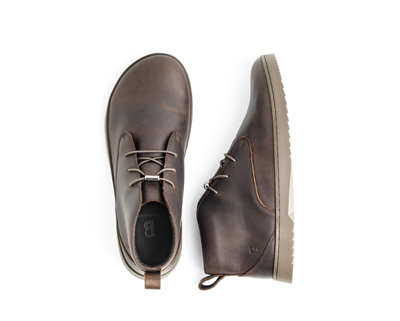
This is exactly why Birchbury built the Carnforth: Barefoot Chukka Boot. The spec sheet:
- Plain toe that reads classic
- Wide toe box, so toes spread
- Zero-drop design
- Handcrafted with American full-grain leather that resists water
- Elastic laces that keep the classic open lacing look with none of the fiddling
Shape sorted. Size is the next place people go wrong.
How a Chukka Should Fit, and Whether to Size Up
Don't size up to buy toe room. You get heel slip, a boot that flops, and laces cranked down on two eyelets trying to rescue it.
A chukka fits right when three things check out:
- Snug grip at the heel and ankle, locked in with no lift when you walk
- A thumb's width of space ahead of your longest toe
- A toe box shaped like your foot, because width beats length
Match the shape of your foot first. A narrow toe box in the right length still pinches.
To get the size right:
- Measure your foot length and width in inches.
- Check the sizing guide.
- Ignore your sneaker size.
Break-in should mean the leather softening, not your toes rearranging. And thicker socks change fit more than half a size ever will.
Once the boot fits, it still has to earn its keep in an actual outfit.

What You Can Actually Wear Chukkas With
Short version: jeans, chinos, and slim dress trousers, yes. Suits and black tie, no.
Jeans, yes. Dark or raw denim with a slight break over the boot.
Chinos are the easiest win of all; chukka boots might as well exist for them. Dress trousers work too, if you pick smooth leather and a slim leather sole.
Suede desert boots with a suit? No. A two-eyelet ankle boot can't carry a formal suit, and black tie is out of the question.
In practice, the chukka sits between a dress shoe and a sneaker, which is how a chukka stacks up against a casual sneaker on weekends.
Color ranking:
- Dark brown
- Tan
- Black
- Grey, last on the list but a strong odd pick
Which brings us to the only test that matters.
Buy the Pair That Still Fits at 6pm
The history is good trivia. The sole and suede choices matter. The color ranking will save you a return or two.
None of it decides whether the boot survives in your rotation. Shape does.
Three takeaways worth keeping:
- Shape over specs. The boot should match the foot you actually have.
- Construction over leather grade. Goodyear welt or stitchdown means it can be resoled.
- Correct length plus a wide toe box beats sizing up. Every time.
Chukka boots that match the foot you actually have, wide at the toes where you're wide at the toes, still feel right when the workday ends. A tapered toe box just looks right in the box.
Buy for 6pm, not for the shelf.
A few questions come up every time. Quick answers below.
Quick Answers Before You Buy
Are Chukka Boots Still in Style for Men?
Yes. The silhouette has survived roughly a century because it's simple: two eyelets, clean lines, nothing to date it. Trends cycle around chukka boots. The boot itself doesn't move.
Can a Wide Toe Box Chukka Still Look Sharp at the Office?
Yes. The width lives inside the boot, not on the outside. A plain toe in smooth leather reads sharp across a desk, and nobody's measuring your toe box in a meeting.
How Long Do Chukka Boots Last?
Depends on the sole. A Goodyear welt or stitchdown boot takes resoling and can outlive a cemented pair by years. Buy the construction, not just the leather.
Prices accurate as of June 2025.

Matthew Tran
Founder, Birchbury
Matthew Tran is a mechanical engineer who founded Birchbury. He started the company after struggling to find dress shoes that didn’t hurt — and barefoot shoes that didn’t look out of place at work. That gap led him to design his own: a wide-toe-box, zero-drop shoe made from full-grain leather, built specifically to look like a normal shoe. Birchbury has since been worn by lawyers, chiropractors, restaurant managers, and anyone else who spends their day on their feet and refuses to suffer for it.
More about Matthew Tran →